1973
A child of nine years old sits with legs crossed on the classroom floor along with his classmates, waiting, as the teacher has instructed, for the school library trolley to arrive, as it does once per week.
For some of the class, it is: “Oh no, not reading again.” or “There are no comics. I want the Beano!” But for young Jerry A Thomas, it is twitchy time.
“Come on, come on. I want to choose a book.”
As the trolley is wheeled into the classroom by the member of staff responsible for the small school library, Jerry leaps up, along with a few other children, and sprints towards it. Before the staff can react, small hands are already lifting and lowering books. Jerry does not waste time with that. It is too slow.
With the books lined up in rows, their spines facing outward, he bends his body almost ninety degrees and speed-reads the titles and authors while pushing his way between the books and the scrambling children.
“I need ghost stories. Something creepy.” Jerry mutters to himself as he ignores a knee to his cheek from a girl with particularly bony knees. Then he stops. Almost at the end of a row. His body now blocks nearly the entire lower half of one side of the trolley. Knees and shins poke him, while an elbow jabs into his shoulder as another child reaches for a book above his head.
“Grimm’s Fairy Tales.” He pauses for a moment. “That sounds kind of creepy. I will take it.” Jerry pulls the book from the lower trolley shelf and crawls out of the melee, victorious.
9:00pm;
Mother orders, “Lights out.”
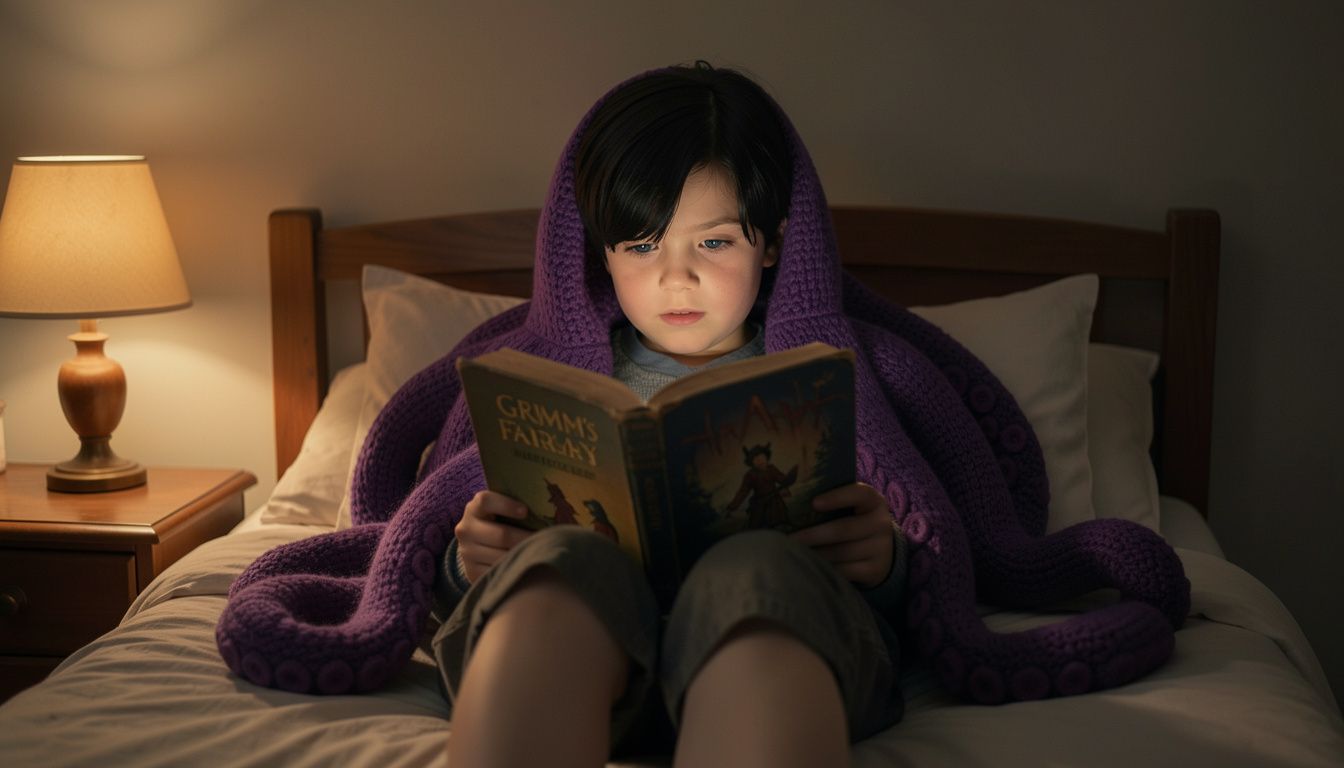
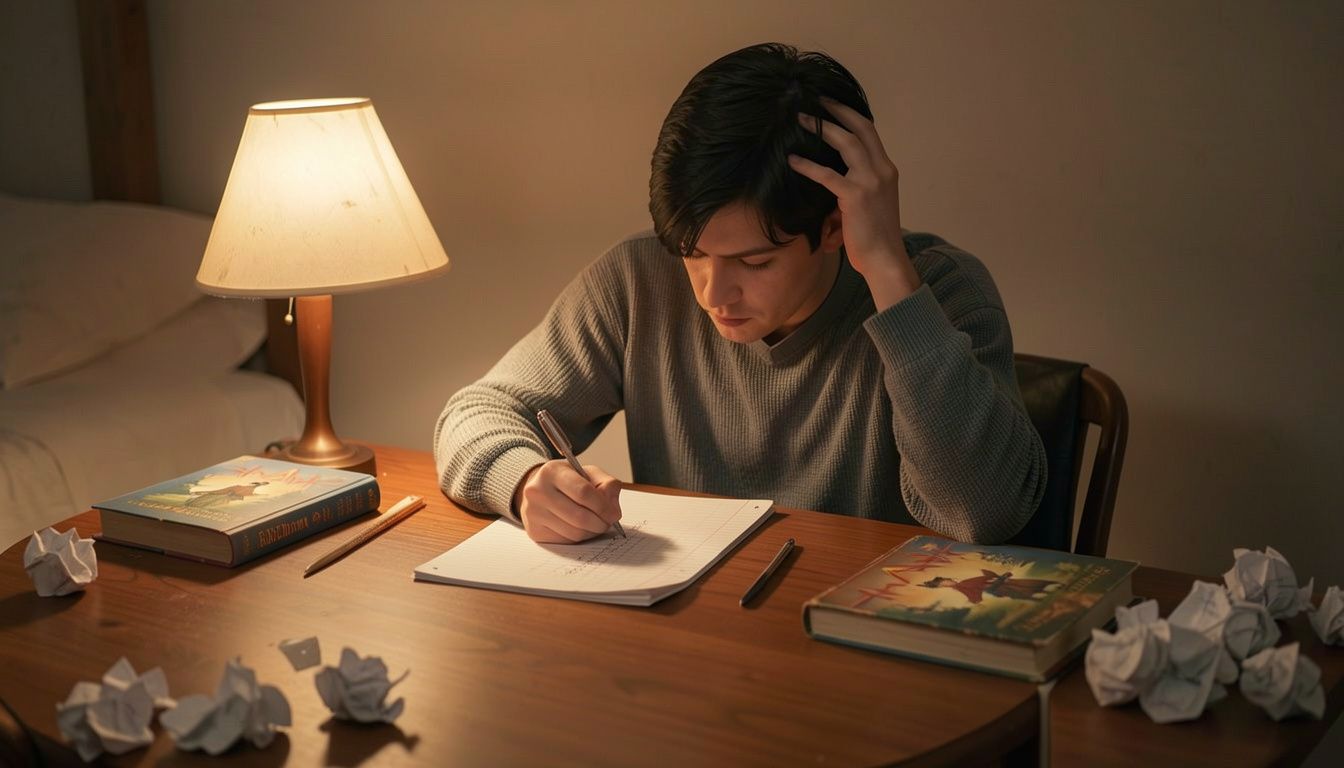
Jerry waits. The bedroom door closes. He waits some more. Then come the familiar sounds: footsteps descending the stairs, one step at a time. A pause. Then the lounge door opens. The moment he hears it, Jerry reaches under the table lamp and pushes in the switch. Illumination. Leaning over the side of his bed, he retrieves the book from its hiding place underneath.
“Nothing to be scared of yet, because it is not midnight yet,” Jerry whispers aloud to himself.
He props
Ogden, the large, deep-purple, hand-knitted octopus made lovingly by his nan, behind his head as a cushion. Then, with practised precision, he pulls four woolly tentacles over his left shoulder and four woolly tentacles over his right.
Now properly equipped for the reading of ghost stories, mysterious happenings, and anything else that might emerge from the pages of Grimm’s Fairy Tales, Jerry is ready to begin.
When I think back to that book and myself sitting in bed, I definitely recall not understanding much of what I was reading. There appeared to be a storyline to follow in most of the tales, but I was too young to grasp much of the content. The prose was just beyond me, as if I were trying to read a different language. Yet I was still drawn in by the darkness and, in some places, the absurdity that emanated from each page I turned.
For instance, from the tale The Story of the Youth Who Went Forth to Learn What Fear Was. (Could the Brothers Grimm not come up with a longer title?)
“...at length with a loud scream, half a man came down the chimney and fell before him.”
“Hollo!” cried he. “Another half belongs to this. This is too little!”
Then, only a few sentences later:
“Then still more men fell down, one after the other; they brought nine dead men’s legs and two skulls, and then set them up and played nine-pins with them...”
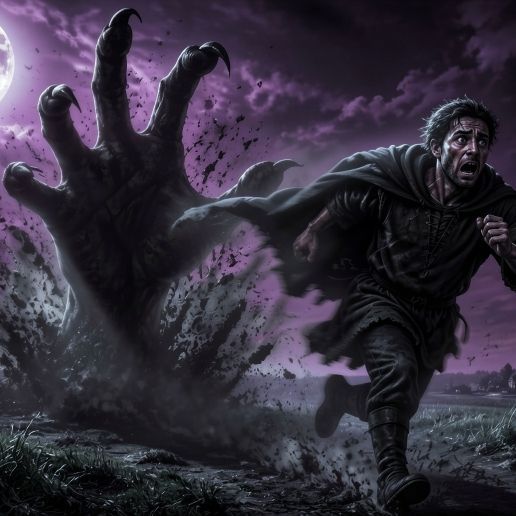
I mean, it made no sense. There was no logical reason for bits of people to fall down a chimney, followed by more people and then use body parts to go bowling. I understood that the content was intended to make the youth fearful of the situation, but there was no explanation of how any of it came about. Why were pieces of people falling down chimneys? Where had they come from? Why did they suddenly decide to play nine-pins with body parts? The whole tale, and many others that I came to understand better in later years, were born from folklore, where absurdity mixed with dread creates the desired effect.
I was hooked.
The fluffy adaptations rewritten for children, or later adapted for film, held nothing for me.
They were all lies.
The original tales had death, blood, curses, warnings, evil bargains, and plenty of:
“Woe betide you, should thou not heed my word!”
Those were the stories I wanted.
1978
By 1978, Jerry A Thomas was over halfway through secondary education and, for English Literature, he and his classmates were required to read and analyse...
(drum roll please)
Shakespeare.
To be bored or not to be bored, that was the question occupying Jerry’s mind. Now, I must admit there was plenty of death and blood. There were even three witches. (What was the play called again? MacBoring or something like that. At least, that was what Jerry thought at the time.)
As a result, a trip to the local library was undertaken and Jerry returned home with
The Complete Grimm Fairy Tales tucked safely under his arm. Following every homework session spent struggling through the brain-fog of analysing Shakespeare over the next two years, Jerry would immerse himself in his favourite book. In fact, the library copy was probably a record holder for renewals. Occasionally, however, there would come a dreaded interruption.
“I am sorry, Master Thomas, but someone has reserved this book. You will need to return it and place a reservation of your own if you wish to borrow it again.”
“Curse you, other Grimm lover!”
The waiting period that followed always felt entirely unreasonable.
Unfortunately, Jerry did not qualify to take the English Literature O-Level examination. However, in English Language, things turned out rather differently. For his O-Level examination, Jerry wrote a narrative piece entitled
The Shadow, which helped him achieve a respectable Grade B.
Thank you, Brothers Grimm.
Looking back now, I suspect the constant diet of strange tales, dark forests, mysterious figures, curses, danger and consequences did far more for my imagination than endlessly trying to determine what Shakespeare was attempting to say. That is not to diminish Shakespeare. It is simply to acknowledge that, at fourteen or fifteen years old, I knew where my interests lay.
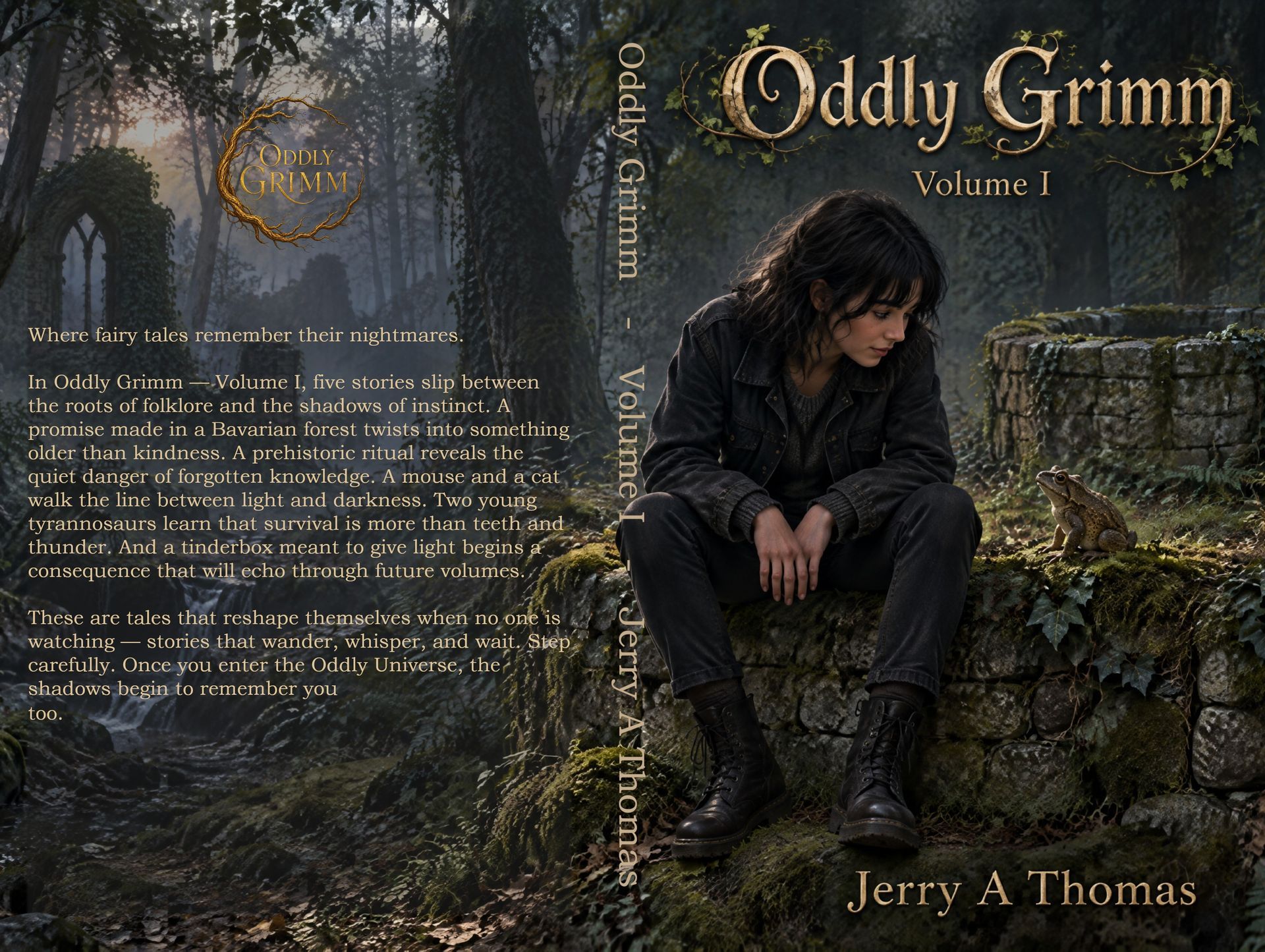
And so it was that Jerry A Thomas rediscovered, and perhaps cemented, his love for those tales.